
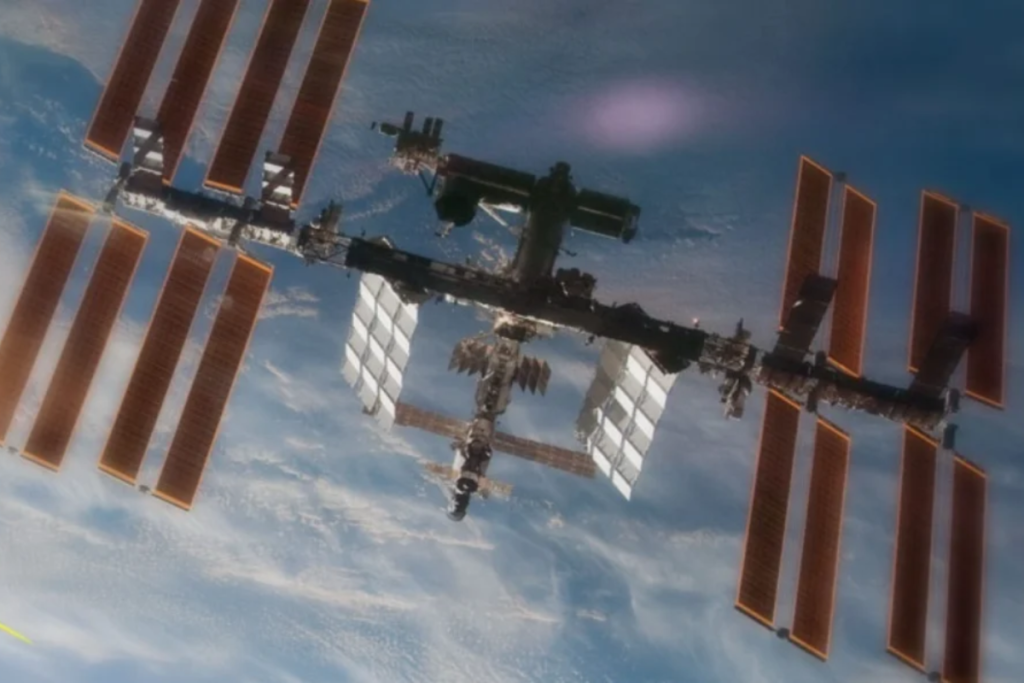

Los Angeles may be known for its movie stars, but there are some pretty incredible sights happening far above Hollywood too.
The International Space Station (ISS) regularly passes over Southern California, and you can actually watch it glide across the sky with your own eyes.
NASA says the station is visible because its enormous structure reflects sunlight. This makes it look like a bright star moving steadily across the night sky.
And with World Space Week taking place October 4–10, there couldn’t be a better time to look up.
When to see the ISS over Los Angeles
Look toward to south-southwest and watch for the ISS to be traveling toward the northeast. According to current orbital tracking data, the next visible passes over Los Angeles are:
- Monday, October 12: around 5:49 a.m.
- Wednesday, October 14: around 5:51 a.m. — This is expected to be the best time to see the ISS because it will be 66 degrees above the horizon.
- Thursday, October 15: around 5:04 a.m.
- Friday, October 16: around 4:17 a.m.
The times can change as NASA updates the station’s orbital trajectory, so it’s worth checking the official NASA Spot the Station tool before heading outside.
How to know exactly when it will fly over
The easiest way to plan your ISS sighting is with NASA’s free Spot the Station service.
You can enter Los Angeles as your location to see upcoming viewing opportunities, including the exact time the station will appear, how long it will remain visible, its highest point in the sky and the direction it will travel.
NASA also offers the Spot the Station mobile app, which can send notifications when a visible pass is coming up.
One important thing to remember is that not every ISS pass is visible from the ground. The best opportunities happen around dawn or dusk, when the sky is dark enough to see the station while it is still illuminated by the Sun.
What does the ISS look like?
Don’t expect to see a tiny spaceship with visible solar panels. From the ground, the ISS looks more like a bright, steady star moving surprisingly quickly across the sky.
Unlike an airplane, it doesn’t flash or change direction. And because the station is traveling at roughly 17,500 mph, you’ll notice it moving across the sky much faster than a typical star or planet.
The station orbits Earth roughly every 90 minutes, traveling about 250 miles above the planet. It has been continuously occupied by astronauts since November 2000 and has hosted hundreds of people from around the world.
You don’t need a telescope
One of the best things about an ISS flyover is how easy it is to watch. You don’t need a telescope, binoculars, or any special equipment. NASA specifically recommends viewing the station with the naked eye.
For the best chance of seeing it, find somewhere with a relatively unobstructed view of the sky. A rooftop, backyard, or park can work, as long as trees and buildings aren’t blocking the direction of the pass.
Give yourself a few minutes before the listed time so you’re already looking in the right direction.
If you’re up early in Los Angeles this October, take a minute to look up. You might just catch a glimpse of a crew of astronauts flying silently overhead.
