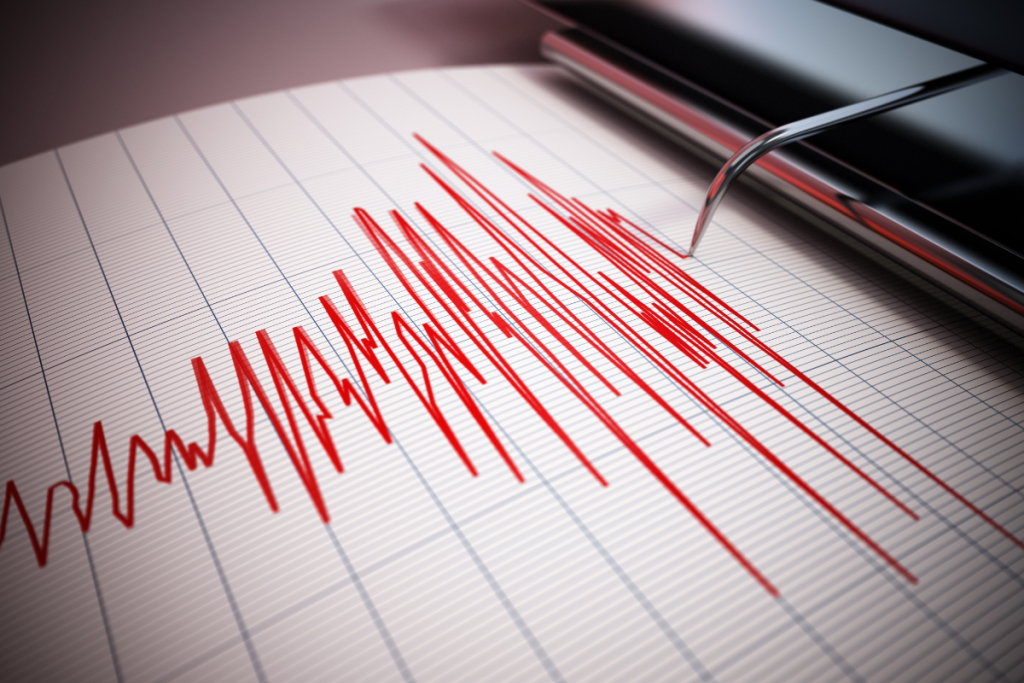

A team of UC Riverside scientists has developed a new method that could help identify where the world’s largest earthquakes are most likely to rupture — without trying to predict exactly when they will happen.
The research, published in Geophysical Research Letters, uses subtle movements of Earth’s surface to find parts of major faults that are locked and quietly accumulating strain. In a test using data from Russia’s Kamchatka Peninsula, the method identified a heavily locked section that closely matched where the magnitude 8.8 earthquake in 2025 eventually ruptured.
For California, the research is particularly interesting because the scientists are now exploring whether similar techniques could shed light on the state’s own earthquake faults.
The method looks for faults storing energy
The researchers, geophysicists Gareth Funning and Axel Periollat, are focusing on what happens to faults in the years between major earthquakes.
When tectonic plates become locked together, they don’t simply sit still. The surrounding crust slowly deforms as strain builds up. By analyzing this subtle movement with GPS measurements, the team developed an algorithm that can identify sections of a fault where that strain is concentrated.
Those areas are sometimes called asperities — sections of a fault that resist movement until enough stress accumulates for them to rupture. The important distinction is that the technique is designed to answer “where?” rather than “when?”
Researchers tested it against a massive earthquake
Per UC Riverside News, to see whether the approach worked, the team studied the Kamchatka subduction zone, where the Pacific Plate dives beneath the Okhotsk Microplate.
Their model identified a major locked region before comparing it with what happened during the July 30, 2025 magnitude 8.8 Kamchatka earthquake. The study found that smaller high-locking areas lined up with the location where the earthquake began, while the broader locked region corresponded closely with the eventual rupture.
That doesn’t mean scientists predicted the earthquake itself. As UC Riverside News mentions, the researchers emphasize that their method cannot determine when an earthquake will happen or how large a resulting tsunami will be. Instead, it could eventually help identify the sections of major faults that deserve the most attention for long-term hazard planning.
The researchers are applying the approach to other major earthquake zones, including Japan, Mexico, New Zealand and the Pacific Northwest. They are also investigating whether similar methods could be useful on California’s faults. Funning specifically pointed to the Hayward Fault in the Bay Area, which contains both creeping and locked sections, as a possible test case for the technique.
However, that doesn’t translate into a prediction that a major California earthquake is imminent. Instead, the potential value is more practical: if scientists can better map where strain is accumulating, planners could have a clearer picture of which parts of a fault pose the greatest long-term seismic hazard.