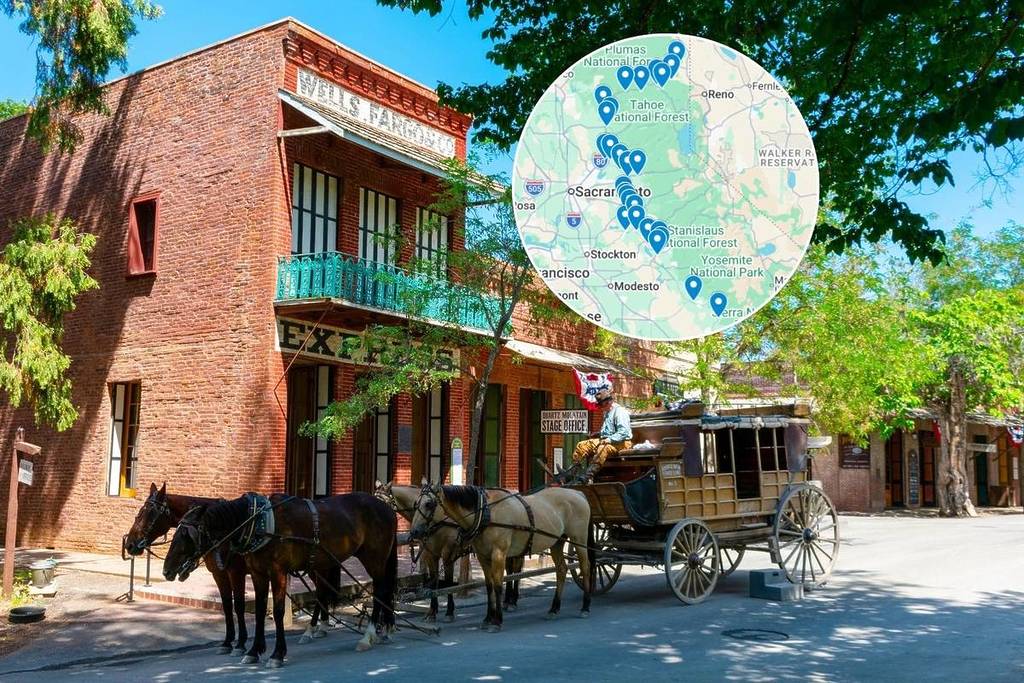

California’s State Route 49—better known as the Gold Rush Trail or Golden Chain Highway—winds through the heart of Gold Country, linking more than two dozen historic towns that played important roles during California’s Gold Rush between 1848 and 1855.
The route takes its name from the “49ers,” the thousands of fortune seekers who flocked to California in 1849 in search of gold. That legacy is also reflected in the shape of California’s state highway signs, which resemble a miner’s spade.
Much of Highway 49 follows the same corridor once traveled by prospectors through the Mother Lode region.
Best Gold Rush towns on Highway 49
Highway 49 begins in Oakhurst, about 14 miles south of Yosemite National Park, and travels roughly 307 miles north through the Sierra Nevada foothills before ending in Vinton, near the Nevada border. Along the way, the road passes a remarkable collection of former mining settlements, preserved downtowns, historic parks, and scenic detours.
- Downieville – Scotsman William Downie and a group of African American miners established Downieville along the Yuba River, and it’s still known as agateway to The Lost Sierra.
- Nevada City – The annual Victorian Christmas celebration in Nevada City looks especially magical among the Gold Rush-era buildings.
- Grass Valley – Famous for its Cornish heritage and quartz mines, Grass Valley invites visitors to explore Empire Mine State Historic Park
- Auburn – One of the Gold Rush’s major express and supply hubs, Auburn still preserves its 19th-century charm.
- Coloma – James W. Marshall first discovered gold here in 1848. Visitors can explore Marshall Gold Discovery State Historic Park, which has a replica of Sutter’s Mill.
- Placerville – Known as “Hangtown” for its rough Gold Rush-era past, Placerville is the region’s only town with a municipally-owned gold mine.
- Amador City – See a handful of historic buildings and a Gold Rush museum in California’s smallest city.
- Sutter Creek – The well-preserved Main Street still has original brick buildings and historic mansions.
- Angels Camp – This city is still known for the epic Calaveras Frog Jumping Jubilee in May, as well as several complex cave systems.
- Columbia – See costumed performers at Columbia State Historic Park, a living history park with California’s largest collection of Gold Rush-era buildings.
- Sonora – Known as the “Queen of the Southern Mines,” Sonora was founded by Mexican miners from Sonora, Mexico.
- Jamestown – Visit Railtown 1897 State Historic Park to learn more about the “Gateway to the Mother Lode.”