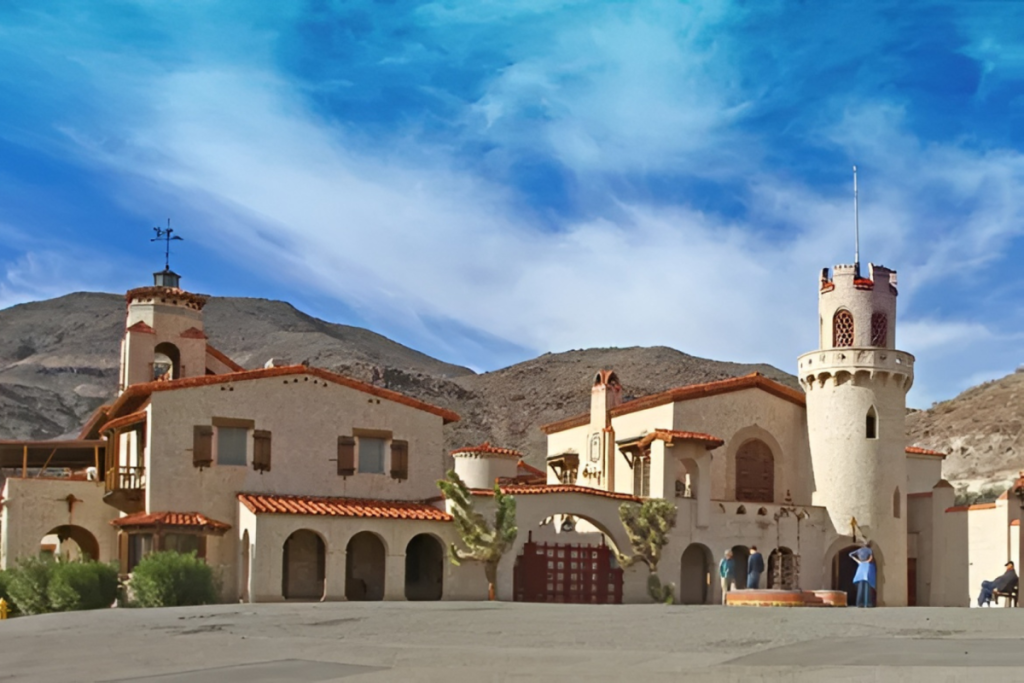

In the middle of the unforgiving Death Valley National Park, an elaborate Spanish-style estate once welcomed thousands of curious visitors every year. Built in the 1920s by a wealthy Chicago businessman, Scotty’s Castle became one of the desert’s most unusual attractions, complete with lavish furnishings, striking architecture, and a massive theater organ featuring 1,121 pipes.
However, almost a century later, the historic property remains closed to the public… And while restoration efforts continue, taxpayers are spending more than $350,000 annually just to store and preserve the estate’s collection, according to SFGATE. The storage costs have added up to nearly $5 million over the past several years, with no confirmed timeline for a full reopening.
The Chicago tycoon who built a $2 million desert castle
The story of Scotty’s Castle began with Albert Mussey Johnson, a wealthy Chicago engineer who first met Walter Scott, better known as Death Valley Scotty, in 1904. Scott had developed a reputation as a gold prospector, although much of his fortune came from convincing investors to finance his supposed mining adventures.
The two became lifelong friends, and after several trips to Death Valley, Johnson and his wife, Bessie, decided to build a permanent vacation retreat in Grapevine Canyon, away from the city and surrounded by the rough desert landscape.
Construction started during the 1920s, and the couple eventually invested approximately $2 million in the sprawling property. The Great Depression brought work to a halt in 1931, leaving parts of their ambitious plans unfinished.
Still, the estate became a major attraction, drawing as many as 100,000 visitors annually before its closure.
Scotty’s Castle: closed for more than a decade
The property’s troubles began on October 18, 2015, when a massive flash flood swept through Grapevine Canyon. Water, rocks, damaged road sections, power poles, and other debris rushed through the canyon at an estimated 3,200 cubic feet per second, causing extensive damage to the estate.
The structures were subsequently deemed unsafe, forcing the National Park Service to close the attraction while repairs got underway. Then, in 2021, another disaster struck: a fire damaged or destroyed several buildings on the property, including the garage that had previously served as its visitor center.
Although restoration and preservation work has continued, a full reopening date remains uncertain. In the meantime, the estate’s historic collection requires specialized, museum-quality storage to protect its furnishings and other artifacts.
That responsibility comes with a considerable price tag: more than $350,000 every year. For a landmark that once welcomed thousands of people through its doors, its most expensive chapter is now unfolding behind closed doors.
For more, follow us on Facebook, Instagram, TikTok, and now WhatsApp!