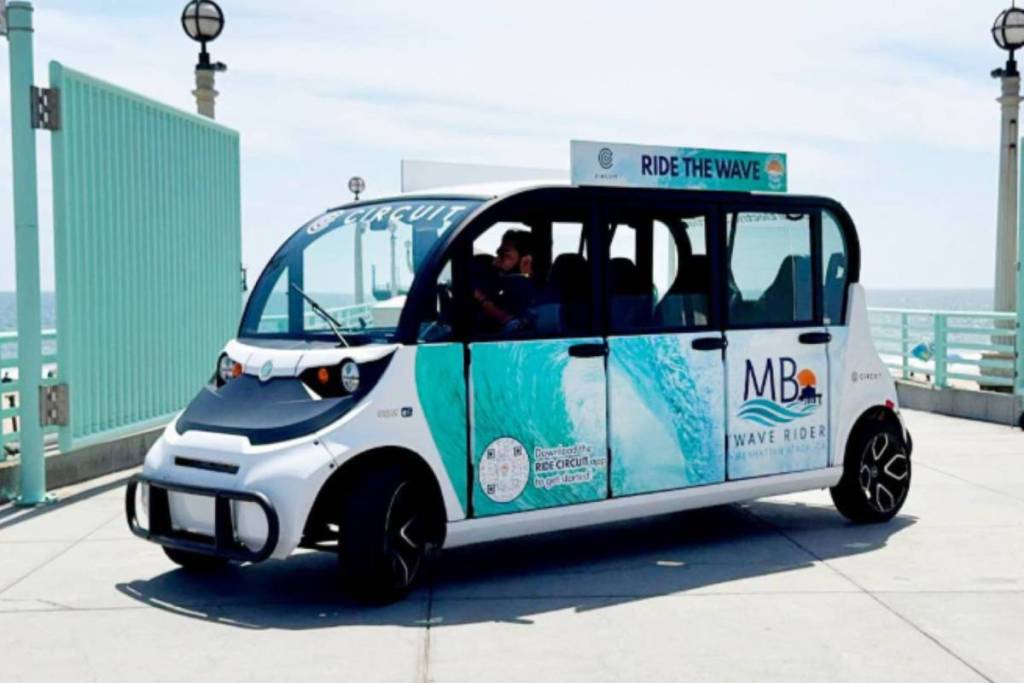

A new transportation pilot in Manhattan Beach is rethinking what local transit looks like along the coast. The program, called Wave Rider, replaces traditional bus routes with on-demand electric shuttles that arrive when you request them through an app.
This new microtransit system feels closer to rideshare than public transportation. The service is being tested as a six-month pilot. Later, city officials will decide whether it becomes permanent based on usage data and performance.
✨ How to ride the Wave Rider
Riding Wave Rider is designed to feel simple and modern. You download the Circuit app, enter your destination within city limits, and request a pickup.
A nearby electric shuttle is then dispatched straight to you, and it takes you directly to your destination or shares the trip with other riders going in a similar direction.
There are no fixed routes or scheduled stops. So the system adapts in real time to demand rather than following a preset map.
💸 Flat fares with no surge pricing
The pricing structure is intentionally straightforward. Each ride costs $5 per person, and riders aged 55 and older will pay $2.50 starting in July. Use code FREE15 in the Circuit app for 3 free rides during June.
Plus, the system does not use surge pricing. It makes costs predictable regardless of time of day or demand levels.
📍 Where Wave Rider operates
The service operates entirely within Manhattan Beach city limits, with one key exception that allows riders to connect to the Metro K Line at Douglas Station in nearby El Segundo.
Within the city, it serves residential neighborhoods, commercial areas, and beach destinations, focusing specifically on short trips that are too long to walk but too short to justify driving.
🚐 What the fleet looks like
The Wave Rider fleet is small and fully electric. It includes:
- compact neighborhood electric vehicles designed for dense areas
- standard electric sedans that serve wider coverage zones
- one wheelchair-accessible van to ensure ADA accessibility
Some trips are shared with other passengers, while others are direct depending on routing efficiency.
🧪 Why the city is testing this
The program is funded through local transit revenue and is being treated as a controlled experiment in urban mobility. Over the six-month pilot, the city will collect detailed data on rider demand, trip patterns, and system efficiency to evaluate whether this model should be expanded, modified, or discontinued.
City officials have framed the project as a way to understand whether flexible, app-based transit can reduce short car trips in a beach city where driving is still the dominant form of transportation.
🌊 The bigger shift behind it
Wave Rider is not positioned as a replacement for traditional transit, but rather as a layer that fills in the gaps between walking, biking, and driving. It targets the small everyday trips that often default to car use, such as errands, beach visits, and local dining.
While the pilot is still in its early stages, it reflects a broader shift in how smaller cities are experimenting with software-driven transportation systems that prioritize flexibility over fixed infrastructure.